

 No Comments
 380 ACP. 380 Auto. 9mm Browning. 9mm Corto. 9mm Kurz. 9mm Short. Call the semi-automatic pistol cartridge whatever you like!
Just don’t call it especially powerful. Despite sharing the same bullet diameter as the ever-popular 9mm, the 380 ACP’s bullet typically weighs significantly less and achieves a comparably lower muzzle velocity.
For context, consider Winchester product no. W9MMLF: a 9mm cartridge loaded with a 95 grain bullet which exits a 4” barrel at 1,225 fps velocity. Its muzzle energy equals 317 ft lbs. Now compare that to Winchester product no. WC3801, which delivers its 95 grain bullet out of a (shorter) 3.75” barrel at a velocity of 955 fps and has muzzle energy equaling 192 ft lbs. It is only around 61% as powerful as the longer cartridge!
Good Things: Small Package
That’s just one example, but it illustrates the most important thing about the 380 ACP: It is substantially weaker than most other rounds Americans favor for concealed carry. The 357 Magnum, 10mm Auto, 40 S&W, and even the 38 Special can all easily outdo the 380 ACP.
But that’s OK. The 380 ACP makes up for its weakness by being something very useful to concealed carriers – small – hence the reason why pistols chambered for it are so light and easy to obscure behind folds of clothing. Better yet, the 380 ACP’s recoil is agreeably gentle, thereby facilitating faster follow-up shots and making life easier for shooters with smaller hands and lighter frames.
All of that is to say that target practice is important if you would ever entrust your safety to the 380 ACP. Target practice is essential to successfully wielding any firearm in self-defense, although shot placement is unarguably more important when it comes to lower-powered ammunition. A 380 ACP won’t inflict nearly as much damage to its target as a beefier round, but a well-placed shot to the head or the heart is nearly certain to produce the desired result during a life-threatening altercation.
This article recommends several excellent choices for 380 ACP target ammo. But before we get to it, let’s cover the basics every novice shooter must know about 380 ACP.
Let’s proceed to our all-time favorites for target shooting.
Top 380 ACP Ammo Options for Range Training
Federal American Eagle
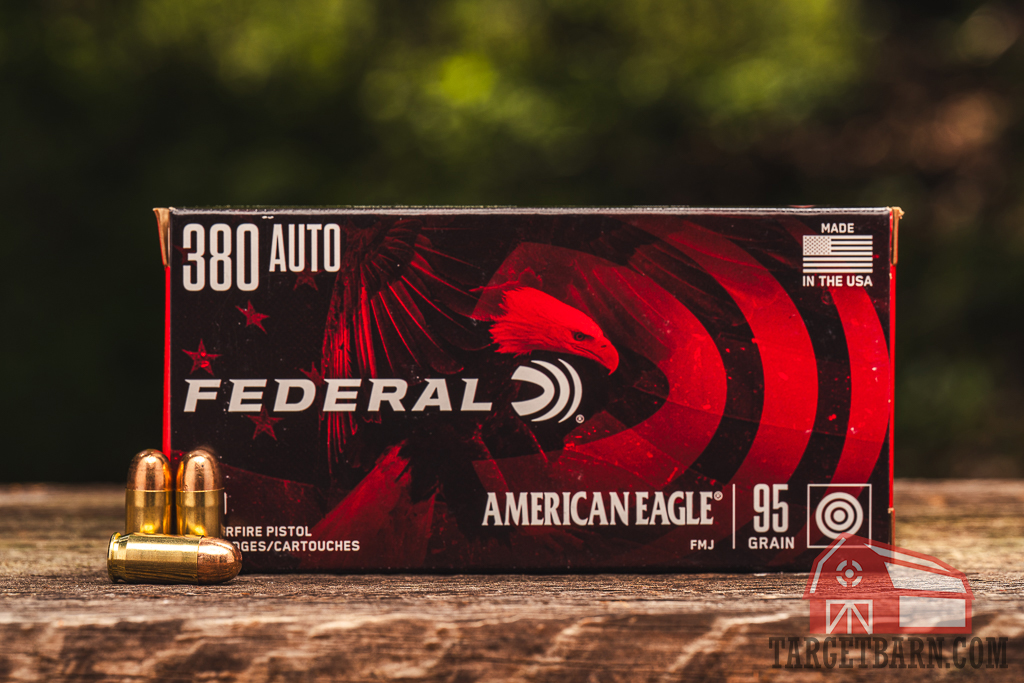
Federal Premium has produced fine ammunition for over one century, and now does so in Anoka, Minnesota: “The Halloween Capital of the World,” no less.
The only scary thing about Federal’s American Eagle series target ammo is how reliably it performs. Consistent cycling, recoil, and point of aim all await when you invest in Federal’s 380 target ammo.
If you can find it for sale – and if you’re trying your best to avoid exposure to heavy metal – then give Federal’s American Eagle Indoor Range Training (IRT) series ammo a whirl. It’s loaded with lead-free bullets and primers!
| Range (yds) | Velocity (fps) | Energy (ft lbs) | Elevation (in) |
| 0 | 1110 | 192 | -0.2 |
| 25 | 1062 | 175 | 0.9 |
| 50 | 1022 | 162 | 0.0 |
| 75 | 987 | 151 | -2.9 |
| 100 | 957 | 142 | -8.1 |
| 0 | 980 | 203 | -0.2 |
| 25 | 937 | 185 | 1.2 |
| 50 | 900 | 171 | 0.0 |
| 75 | 867 | 159 | -3.8 |
| 100 | 838 | 148 | -10.5 |
Blazer Brass
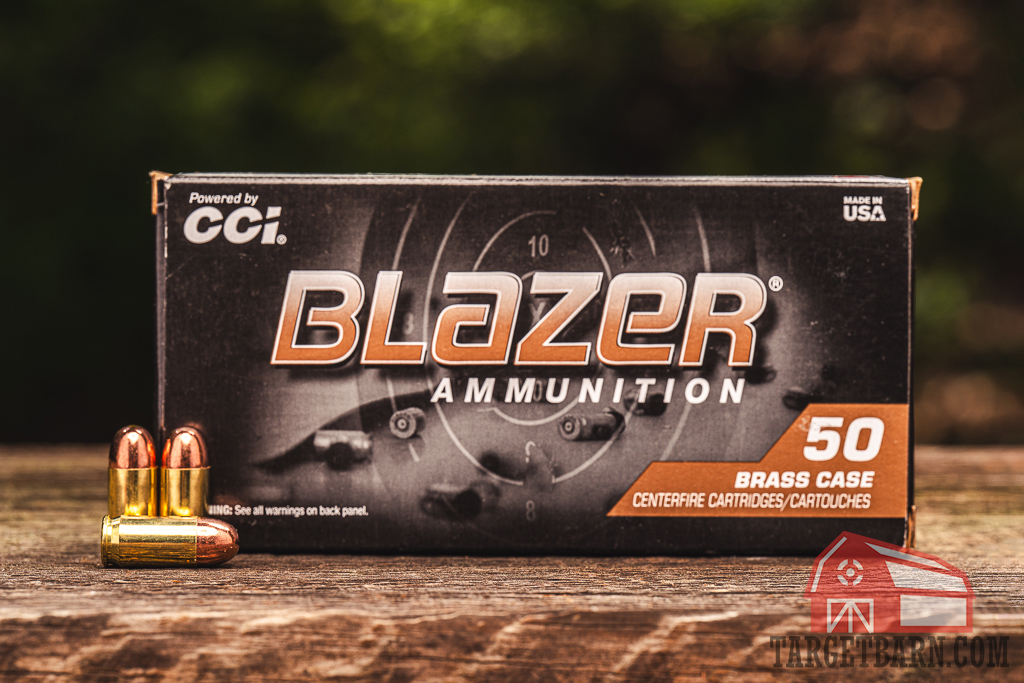
CCI introduced the Blazer label back in the ‘80s so they could market their novel aluminum cases. The brand became so popular that CCI began loading Blazer ammo with brass cases, which is what we’re recommending to you here.


Aluminum (and steel, for that matter) cases aren’t necessarily unreliable. Some firearms actually seem to prefer the cheaper alternatives. Just take care, because other guns vehemently refuse to function with anything other than brass cases.
Like Federal, CCI is owned by Vista Outdoor. Blazer ammo originates from Idaho, thus proving that the state can produce more than potatoes.
| Range (yds) | Velocity (fps) | Energy (ft lbs) | Elevation (in) |
| 0 | 945 | 188 | -0.2 |
| 25 | 915 | 177 | 1.2 |
| 50 | 888 | 166 | 0.0 |
| 75 | 863 | 157 | -3.9 |
| 100 | 840 | 149 | -10.8 |
Speer Lawman
- Product no. 53608 – Speer Lawman 380 ACP TMJ 95 grain
Speer (also Idahoan) began offering their Lawman series ammo so law enforcement officers could keep their indoor ranges cleaner and healthier. And go figure: IT poses the same advantages to you!
This cartridge is loaded with a TMJ projectile. Unlike an FMJ, a TMJ’s lead core is totally encapsulated by its copper shell, including its base. The boiling-hot propellant gasses of ignition therefore cannot aerosolize any part of a TMJ’s core, which means no lead vapor. The payoff? A much cleaner firearm and indoor range, plus significantly reduced exposure to lead for the shooter.

Occasional exposure to lead vapor isn’t really an issue. But if you plan on spending long hours firing your 380 ACP pistol at an indoor range, then your delicate brain and central nervous system will both thank you for going with TMJ ammo.
| Range (yds) | Velocity (fps) | Energy (ft lbs) | Elevation (in) |
| 0 | 950 | 190 | -0.2 |
| 25 | 920 | 179 | 1.2 |
| 50 | 893 | 168 | 0.0 |
| 75 | 868 | 159 | -3.9 |
| 100 | 844 | 150 | -10.7 |
PMC Bronze
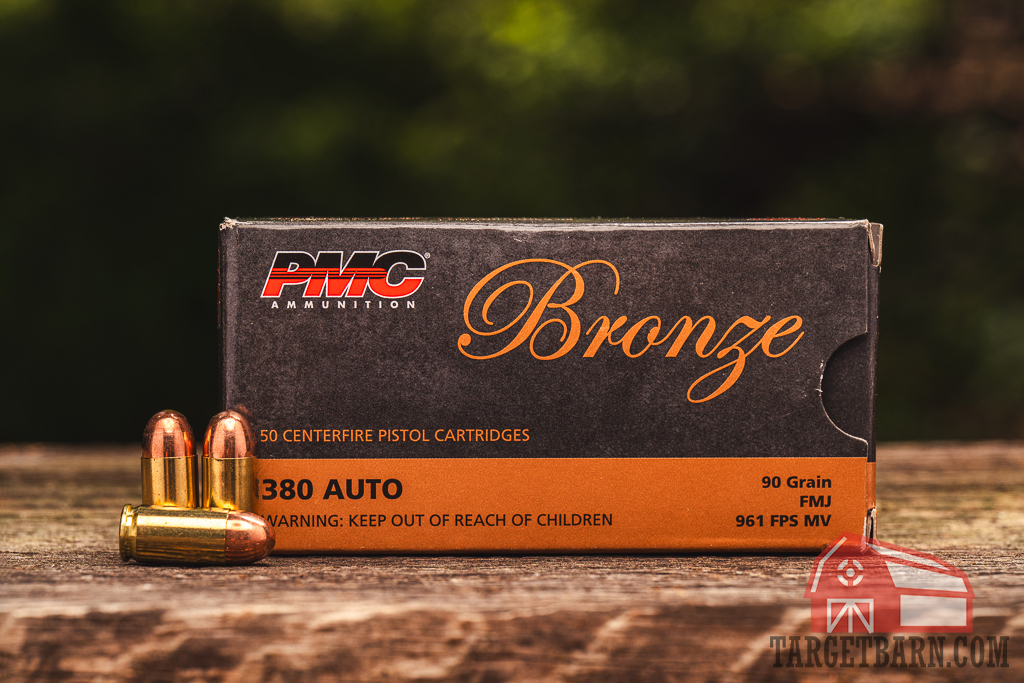
Do you want to pay reasonable prices for extremely consistent and dependable 380 ACP target ammo? Then it’s time to say “안녕하세요!” (which means “Hello!”) to PMC (which stands for “Precision Made Cartridges”).
PMC is a subsidiary of the Poongsan Corporation: South Korea’s largest nonferrous metal (e.g. brass) manufacturer, and the country’s largest producer of ammunition for its military. We don’t believe the Republic of Korea Armed Forces has terribly much use for 380 ACP ammo, but PMC’s high-grade raw materials and exacting quality assurance protocol both make their Bronze label target ammo a top-notch choice for the range, always. Gotta have good ammo when Kim Jong Un’s your next door neighbor!
| Range (yds) | Velocity (fps) | Energy (ft lbs) | Elevation (in) |
| 0 | 961 | 185 | -0.2 |
| 25 | 938 | 176 | 1.2 |
| 50 | 917 | 168 | 0.0 |
| 75 | 897 | 161 | -3.7 |
| 100 | 879 | 154 | -10.1 |
Magtech
Magtech is also the commercial subsidiary of a much larger ammo manufacturing concern: CBC Global Ammunition, which has cranked out excellent material in Brazil ever since it was founded there by a couple of Italians in 1926.
| Range (yds) | Velocity (fps) | Energy (ft lbs) | Elevation (in) |
| 0 | 951 | 191 | -0.2 |
| 25 | 903 | 172 | 1.3 |
| 50 | 862 | 157 | 0.0 |
| 75 | 825 | 144 | -4.1 |
| 100 | 792 | 132 | -11.5 |
| 0 | 951 | 191 | -0.2 |
| 25 | 903 | 172 | 1.3 |
| 50 | 862 | 157 | 0.0 |
| 75 | 825 | 144 | -4.1 |
| 100 | 792 | 132 | -11.5 |
Other Options
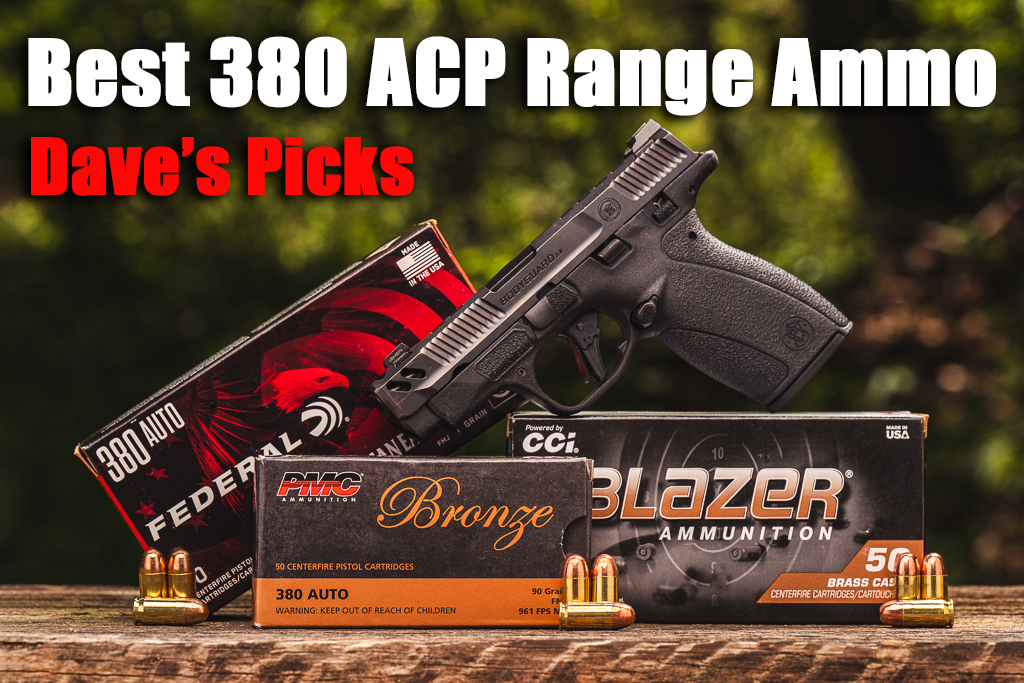
Those are our favorite 380 ACP target ammo picks, but they aren’t your only options. Keep your eyes peeled for any of these brands and labels if you want to plink or train with your pocket pistol until the cows … you know, come home:
- Armscor Precision
- Armscor USA
- Black Hills Ammunition
- Browning BPT
- Federal Premium Range. Target. Practice.
- Federal Premium Train + Protect
- Independence
- Norma
- Remington UMC
- Sellier & Bellot
- SIG Sauer Elite Performance
- Winchester USA
- Winchester W Train + Defend
380 ACP Bullet Weights
There isn’t an enormous range of 380 ACP bullet weights. A few ultralight lead-free 68 to 70 grain bullets exist at the extreme low end of the spectrum (1 grain = 1/437.5 ounces). At the opposite end are a few heavyweight 99 and 102 grain self-defense loads. But for the most part, your options are fairly limited to 85, 90, or 95 grains.
Lighter bullets are generally preferred for target shooting owing to their flatter trajectories and lower cost. Heavier ones are better suited for self-defense, as they conserve slightly more of the momentum they need to penetrate deeply. Yet at the end of the day, such minute differences in weight are unlikely to have a very noticeable effect on performance. You’re ultimately best off selecting the bullet weight you feel most comfortable firing (and which has proven itself most reliable in your pistol).
380 ACP Bullet Types
Target shooting calls for relatively inexpensive and non-expanding full metal jacket (FMJ), total metal jacket (TMJ), or brass enclosed base (BEB) projectiles. Each differs somewhat in design but does fundamentally the same thing: put a hole through something.
Most 380 ACP self-defense ammo is loaded with jacketed hollow point bullets (JHPs). The JHP’s nose cavity fills up with pressurized soft tissue following impact, which in turn forces it to widen out, maximize trauma to the threat, and minimize the risk of over-penetration that could jeopardize innocent bystanders. (Note that Hornady’s eXtreme Terminal Performance (XTP) is merely a high-quality brand name JHP.)
You may also encounter 380 ACP defense ammo loaded with name brand monolithic bullets such as the Xtreme Defense, Xtreme Penetrator, or Maximum Expansion. Such bullets do not deliver terminal expansion. They instead pressurize whichever soft tissue they come into contact with and then almost instantly jet it outward in lateral directions.
Take caution. The 380 ACP’s relatively weak striking energy may cause a JHP to fail to expand. Likewise, any of the monolithics may not produce the extreme cavitation it’s advertised as being capable of. Many 380 SVP shooters prefer FMJ ammo for defense because the non-expanding bullet is able to penetrate deepest!
380 ACP Case Types
Brass is the most popular metal for cartridge cases. This is primarily due to its suppleness, which allows the case mouth to expand on ignition, thereby sealing off the chamber to promote (A) more efficient propulsion and (B) cleaner performance. Brass’s elasticity also enables it to assume its original dimensions following ignition, which helps it eject reliably and also suits it for handloading.
Steel and aluminum are both cheaper metals than brass – hence why some manufacturers load cases made of them (Wolf and Blazer being the two most notable examples, respectively).
Neither alternative to brass is as reliable or clean-shooting. Steel-cased ammo presents yet another problem, because it’s commonly loaded with bi-metal jacketed bullets which contain steel. Many ranges prohibit such bullets for safety reasons, which is why you’d better make sure your range is OK with “magnetic ammo” before investing in a large quantity of it.
380 ACP Chamber Pressure
Technically speaking, “380 ACP +P” does not exist. SAAMI has not published specifications for 380 ACP +P – specifically, the highest chamber pressure such a cartridge could theoretically generate – which means any 380 ACP claiming to be overpressure isn’t officially so.
That hasn’t deterred ammo manufacturers from offering it, however. Underwood notably offers a few 380 ACP +P loads, which are excellent for defense under one condition: your pistol is able to accommodate their substantially higher pressure. The vast majority of contemporary 380 ACP firearms can do so, although it’s advisable to confirm yours is one of them before firing overpressure ammo in it. Ask its manufacturer!
Just don’t use +P ammo for target shooting. Sure, you ought to familiarize yourself with your self-defense ammo’s performance before counting on it to save the day, but firing large amounts of +P ammo will prematurely wear out a semi-auto’s barrel and moving parts. Doing so would also be prohibitively expensive, since almost all +P ammo is premium materiel.
And one more thing: Make sure to order all your 380 ACP range ammo from TargetBarn.com. We ship faster than a lightning-cheetah-rocket, and we’re all lovely, lovely people.